

New satellite AI detects disasters in near real time
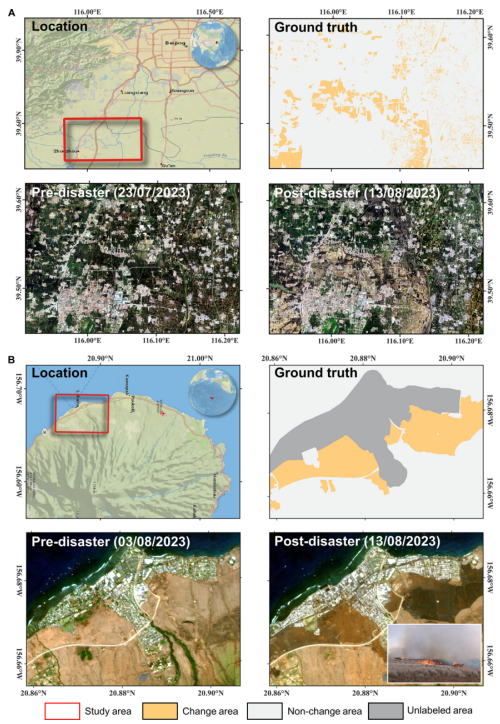
Spatial distribution of the 2 large-scale disaster events in 2023 along with true-color images and ground truth of disaster-affected areas.
FAYETTEVILLE, GA, UNITED STATES, April 2, 2026 /EINPresswire.com/ -- A new artificial intelligence method enables satellites to detect disaster-affected areas directly in orbit. The approach combines change detection and anomaly detection techniques to identify floods, landslides, wildfires, and deforestation using only a single post-disaster image.
Natural disasters such as floods, wildfires, and landslides pose increasing risks to human safety and infrastructure, particularly as extreme weather events become more frequent. Satellite remote sensing plays a crucial role in monitoring disasters and assessing their impacts over large geographic areas. However, most disaster detection methods rely on ground-based processing and require multiple satellite images captured before and after the event. These approaches often demand large storage capacity, intensive computation, and frequent data transmission between satellites and ground stations. Such requirements limit their use for real-time monitoring directly on satellites. Due to these challenges, new technologies are needed to enable efficient and accurate disaster detection within on-orbit computing environments.
Researchers from Beijing Normal University and East China Normal University recently developed a new disaster detection framework called Shield, reported (DOI: 10.34133/remotesensing.0929) on 27 February 2026 in Journal of Remote Sensing. The system enables satellites to detect disaster-affected areas directly in orbit without relying on large datasets or heavy computing resources. By combining the strengths of change detection and anomaly detection, the method can quickly analyze satellite images and transmit only essential information to ground stations, significantly improving the efficiency and timeliness of disaster monitoring.
The proposed Shield (Single-temporal High-spatial Resolution image unsupervised change Detection) algorithm is designed specifically for satellite onboard computing. Unlike conventional techniques that require multiple temporal images, Shield only needs a single post-disaster image combined with lightweight prior knowledge derived from pre-disaster data.
Experiments were conducted across four types of disasters: landslides, floods, wildfires, and deforestation. Results showed that Shield consistently outperformed ten widely used change detection and anomaly detection methods. The model improved the average F1 accuracy score by approximately 24.37% across different disaster scenarios and land-cover conditions.
The method also demonstrated major efficiency advantages. In large-scale case studies, Shield reduced data storage requirements by 5 to 239 times and increased detection speed by up to 136 times, highlighting its strong potential for real-time satellite monitoring applications.
Shield operates through a two-stage workflow designed for resource-limited satellite environments. First, prior knowledge is extracted from pre-disaster imagery using a lightweight autoencoder neural network that learns deep spectral–spatial features from satellite images. These features are clustered through an unsupervised K-means algorithm to generate land-cover categories, and statistical feature distributions for each category are estimated to represent normal surface conditions. When a new satellite image is captured after a disaster, the model extracts deep features and compares them with the stored distributions. The Mahalanobis distance is used to measure deviations between the post-disaster features and baseline distributions, allowing the system to identify abnormal changes that likely correspond to disaster-affected areas. A two-step localization strategy then detects both patch-level and pixel-level changes, enabling the model to rapidly locate large impacted regions while maintaining computational efficiency. The framework was evaluated using datasets from Brazil, Russia, China, and New Zealand covering landslides, floods, wildfires, and deforestation, as well as two large-scale disaster events—the 2023 Zhuozhou flood in China and the 2023 Hawaii wildfire—demonstrating strong robustness and scalability in real-world monitoring scenarios.
The research team emphasized that integrating anomaly detection with change detection provides an effective solution for satellite onboard analysis. The approach allows satellites to process images directly in orbit and transmit only key information about disaster impacts. This capability could significantly improve response speed and reduce the burden on satellite communication systems during emergency monitoring.
The study employed a lightweight autoencoder neural network to extract deep features from satellite images. These features were clustered using the K-means algorithm to generate land-cover categories. Statistical feature distributions were modeled using multivariate Gaussian functions, and anomaly scores were calculated using Mahalanobis distance. The framework was evaluated using high-resolution imagery from Google Earth and PlanetScope satellites, with ground-truth maps manually interpreted by remote-sensing experts.
The Shield framework could significantly enhance next-generation Earth-observation satellites by enabling near-real-time disaster detection directly in orbit. The method reduces data transmission needs and computational burden while maintaining high detection accuracy. In the future, the approach could support rapid monitoring of floods, wildfires, landslides, and environmental changes worldwide. Researchers also suggest that similar techniques could be applied to broader remote-sensing tasks, including land-use change detection and ecosystem monitoring.
References
DOI
10.34133/remotesensing.0929
Original Source URL
https://spj.science.org/doi/10.34133/remotesensing.0929
Funding Information
This study is supported by the National Natural Science Foundation of China (grant no. 42192580).
Lucy Wang
BioDesign Research
email us here
Legal Disclaimer:
EIN Presswire provides this news content "as is" without warranty of any kind. We do not accept any responsibility or liability for the accuracy, content, images, videos, licenses, completeness, legality, or reliability of the information contained in this article. If you have any complaints or copyright issues related to this article, kindly contact the author above.
